When Does Fashion Go Too Far?
by Joie de Vivre
 |
| From head... |
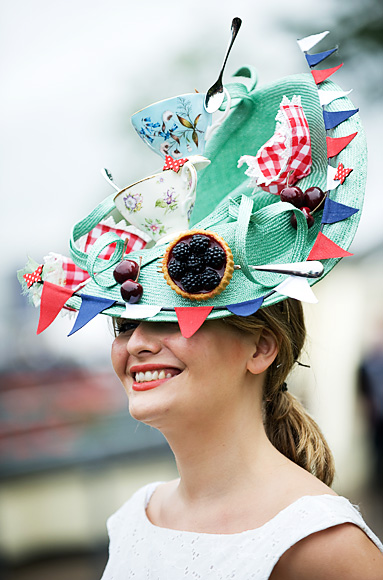
Fashion is a funny thing, meaning funny strange... well funny haha too at times. Take Princess Beatrice's funny fascinator at the recent royal wedding, a fashion statement so emphatic it has spawned dozens of Facebook pages including the following gems: "
Beatrice's Hat - What is it and what can it be used for?" "
Princess Beatrice's Ridiculous Hat Killed Osama Bin Laden," and my faves, "
In loving memory of the deer that gave its life for Princess Beatrice's hat" and "
The awkward moment when you see Princess Beatrice's hat for the first time." ......'
fashion sense' - qu'elle oxymoron.
 |
| ... to toe |
From Cher's Bob Mackie black widow creation to Bjork's swan wrap-around (which I still love!) to Lady GaGa's meat couture, the tabloids have found plenty of fashion fodder over the years. Same goes for this post's focus, footwear. When I Googled 'weirdest shoes' I found shoes in the shape of fish, sandwiches, cars, peeled bananas and dinosaur skeletons, shoes encasing rodents and tarantulas, foot cages, and designs I can't even begin to describe. But outrageous celebrity get-ups and high-concept shoes rarely cross our paths while at the supermarket or attending our weekly book club. What
has managed to infiltrate the mainstream is the formerly taboo
stripper shoe.

Psychologists and sociologists could no doubt double team to come up with a whopper of an explanation as to why this is the case. Without going too far back or into too great of detail I will simply say that over the last decade or so I have seen a decided shift in female attitudes towards women's rights and sex, resulting in a generation of females who pride themselves on their sexual prowess and abilities as a means of exerting power over men... and the men sure don't seem to mind!

Social mores notwithstanding, my guess is the single biggest catalyst for the current skyscraper-high watch-out-or-you'll-break-your-neck foot-deforming shoe craze is the fitness industry...... to be specific, the suburban popularity of the athletic art of Pole Dancing. After packing lunches and dropping off the kids at school, soccer moms across the land are casting aside their Nike's in favor of their lucite platforms and racing to get to Pole Class on time. As for birthdays and bachelorette bashes, fuhget about it -- Vegas and limo bar hopping are out. Pole Dance parties are in!
So where does this leave the rest of us... we without a pole to call our own? -- at the mercy of the designers who are cashing in on the craze with dizzying death-defying designs. In keeping with all memorable trends, the stripper shoe fad has been pushed to its limits with shadowy fetish footwear now creeping into the light. While I am an admitted sucker for some of today's outrageous shoes, my first glimpse of ballet toe-shoe-like extreme shoes immediately brought to mind Chinese foot-binding... a concept which has long intrigued me in a train wreck sort of way.

In teaching etiquette to teen and tween girls over the years, our last day's class has usually emphasized the enormous gap between true beauty and body disfigurement for the sake of fashion. Piercing, tattooing, face lifts, liposuction, botox, breast enlargements, anorexia, corsets, neck-elongation, head-flattening, lip-stretching, foot-binding, we cover it all. Whatever the reason (perhaps nothing more than the fact that our feet are vital to our most basic need to move through our lives and days), I was deeply affected by the concept of foot-binding. Though it is not a topic I broach off-handedly at cocktail parties.
A few years ago, while preparing for a trip halfway around the world, I asked a book shop proprietor friend for suggested reading material for the long flights. The spell & foot-binding story told in the recommended book
Snow Flower and the Secret Fan by Lisa See has remained with me ever since. And while looking it up for inclusion in this post, I just learned that it is being made into a major motion picture starring Hugh Jackman, slated for release next month.
Here are Wikipedia's descriptions of both that specific piece of lyrical fiction as well as a few excerpted facts about its premise, Chinese foot-binding, written by those far more knowledgable than I:
Snow Flower and the Secret Fan is a 2005 novel by Lisa See set in nineteenth century China. In her introduction to the novel, See writes that Lily, the narrator, was born in 1823 — "the third year of Emperor Daoguang's reign". The novel begins in 1903, when Lily is 80 years old. During her lifetime, Lily lives through the reigns of four emperors: Emperor Daoguang (1820–1850); Emperor Xianfeng (1850–1861);Emperor Tongzhi (1861–1875); and Emperor Guangxu (1875–1908). The novel received an honorable mention from the Asian/Pacific American Awards for Literature.
Plot summaryIn rural Hunan province, Lily and her friend Snow Flower are a laotong pair, related more closely than husband and wife. Lily's aunt describes a laotong match this way: "'A laotong relationship is made by choice for the purpose of emotional companionship and eternal fidelity. A marriage is not made by choice and has only one purpose — to have sons.'"
The two girls experience the painful process of foot binding at the same time, and write letters to one another on fans with Nü Shu, a secret phonetic form of 'women's writing.'
In addition to the language itself, the young women learn Nü Shu songs and stories.Both friends are born under the sign of the Horse, but they are quite different. Lily is practical, her feet firmly set on the ground, while Snow Flower attempts to fly over the constrictions of women's lives in the 19th century in order to be free. Their lives differ as well. Although Lily comes from a family of relatively low station, her feet are considered beautiful and play a role in her marriage into the most powerful family in the region. [spoiler content removed here]
The novel depicts human suffering in many ways: the physical and psychological pain of foot binding; the suffering of women of the time, who were treated as property. [spoiler content removed] The detailed treatment of the suffering which Lily and Snow Flower experience in their laotong relationship is a major aspect of the book... [more spoiler content removed here]
FilmThe film version of Snow Flower and the Secret Fan is directed by Wayne Wang and ... stars Li Bingbing, Jun Ji-hyun and Hugh Jackman. Filming in China began in February 2010. Fox Searchlight has acquired North American rights to the film, and plans to release it on July 15, 2011.
Foot-Binding: http://en.wikipedia.org/wiki/Foot_binding excerpts
 |
| The perfect "lotus" foot would measure under 3.5 inches long |
What is clear is that foot binding was first practised among the elite and only in the wealthiest parts of China, which suggests that binding the feet of well-born girls represented their freedom from manual labor and, at the same time, the ability of their husbands to afford wives who did not need to work, who existed solely to serve their men and direct household servants while performing no labor themselves. The economic and social attractions of such women may well have translated into sexual desirability among elite men.
 |
Broken bones and lifelong pain
are part and parcel with foot-binding |
However, by the 17th century, Han Chinese girls, from the wealthiest to the poorest people, had their feet bound. It was less prevalent among poorer women or those that had to work for a living, especially in the fields. Some estimate that as many as 2 billion Chinese women had their feet bound from the late 10th century until 1949, when foot binding was outlawed by the Communists (foot binding had also been banned by the Nationalists, but the Nationalists never had thorough political control over the entire country, and were unable to enforce this prohibition universally).
 According to the author of The Sex Life of the Foot and Shoe, 40-50% of Chinese women had bound feet in the 19th century. For the upper classes, the figure was almost 100%. Generally speaking, footbinding was not as widespread in southern China as in the north. In contrast to the majority of other Han Chinese, the Hakka of southern China did not practise foot binding and had natural feet. Manchu women were forbidden to bind their feet by an edict from the Emperor after the Manchu started their rule of China in 1644. Many other non-Han ethnic groups continued to observe the custom, some of them practised loose binding which did not break the bones of the arch and toes but simply narrowed the foot.
 |
| Fashion hobbles amuck |
What exactly do our current fashion fads and choices say about the 21st century as a culture? Whereas few of us are in danger of mangling our metatarsals as a result of donning extreme footwear, the over-the-top and under-the-heel fashions we collectively covet do serve as signposts of our society's psyche for future generations to study, debate and contextualize in the ongoing saga of mankind's development.

As for myself, I believe in human equality regardless of gender, race, nationality or pay-grade. I have no interest in kowtowing to body image trends or having any "work done" as I mature. Does this mean I will stop shaving my legs or burn my growing collection of corsets? Ah, heck no! And as for shoes to wear with those corsets... I'll gleefully take that little boudoir number at left in a size seven and a half, should you find yourself feeling particularly generous...